Choosing between operating as a sole trader or forming a limited company affects tax, liability, and administration. A sole trader structure keeps setup simple and gives direct control, but personal assets can remain exposed if the business incurs debts. A limited company creates a separate legal entity, which can limit personal liability, yet it brings stricter reporting and compliance duties. The right option depends on expected profits, risk level, and growth plans.
Key takeaways
- Sole traders keep full control, but accept unlimited personal liability for debts.
- Limited companies separate personal and business finances, reducing personal financial risk.
- Sole trader setup stays simpler, with fewer filings and less ongoing administration.
- Limited companies must file annual accounts and a confirmation statement with Companies House.
- Sole traders pay Income Tax and National Insurance through Self Assessment on profits.
- Limited company owners often combine salary and dividends, changing tax planning options.
- Switching structure later is possible, but can trigger extra paperwork and costs.
What a sole trader is in the UK: legal status, control, and typical use cases
In the 2023/24 tax year, HM Revenue & Customs recorded 4.4 million self-assessment taxpayers with self-employment income, making sole trading the UK’s most common business structure (HMRC). A sole trader is not a separate legal entity from the owner, so the business and the individual share the same legal status. That simplicity gives one person full operational control, from pricing decisions to supplier contracts, without the formal governance that companies must follow under the Companies Act.
The trade-off sits in liability and tax administration. Because the owner and business are legally the same, personal assets can cover business debts if the business cannot pay. From a compliance perspective, a sole trader typically reports income and allowable expenses through Self Assessment once per year, rather than filing company accounts and corporation tax returns. For 2025/26, the personal allowance remains £12,570, and the basic rate band runs up to £50,270, which shapes how profits translate into income tax for many sole traders (GOV.UK).
Sole trading suits low-to-moderate risk services where one person delivers the work, such as trades, consulting, tutoring, and local retail. It also fits people testing demand before committing to incorporation, especially where cash flow stays predictable and the owner can manage tax through straightforward record-keeping. If employment status feels unclear, paye vs self-employed: what’s provides a practical comparison of how HMRC treats each arrangement.

What a limited company is in the UK: separate legal entity, directors, and shareholders
Emma runs a Manchester-based marketing consultancy and signs a 12-month contract worth £60,000 with a national retailer. The client asks for a company number, proof of directors, and a contract with a legal entity that can continue if Emma takes parental leave. Emma incorporates, becomes a director, issues one share to herself as the shareholder, and trades through a limited company rather than in her own name.
A UK limited company is a separate legal entity from the people who own and manage it. That separation means the company can enter contracts, own assets, and take on liabilities in its own right. Incorporation creates a public record at Companies House, including the registered office address, directors, and shareholders. As of 2024/25, Companies House charges £50 for online incorporation, and most companies receive a registration number immediately after approval.
Directors run the company day to day and must follow legal duties set out in the Companies Act 2006, such as promoting the success of the company and keeping proper accounting records. Shareholders own the company through shares and usually vote on major decisions, including appointing directors. In many owner-managed businesses, one person acts as both sole director and sole shareholder, but the roles remain legally distinct.
For Emma, the broader benefit is credibility and clearer separation between personal and business risk. If the company faces a claim, liability usually sits with the company, not Emma personally, unless she has given personal guarantees or acted unlawfully. The structure also changes how money leaves the business: the company pays Corporation Tax on profits, and Emma takes income via salary, dividends, or both.
Costs and admin increase, so the numbers matter. A limited company must file annual accounts and a confirmation statement with Companies House, and submit a Company Tax Return to HM Revenue & Customs. Allowable costs can reduce taxable profit; for practical examples, see what expenses can uk.
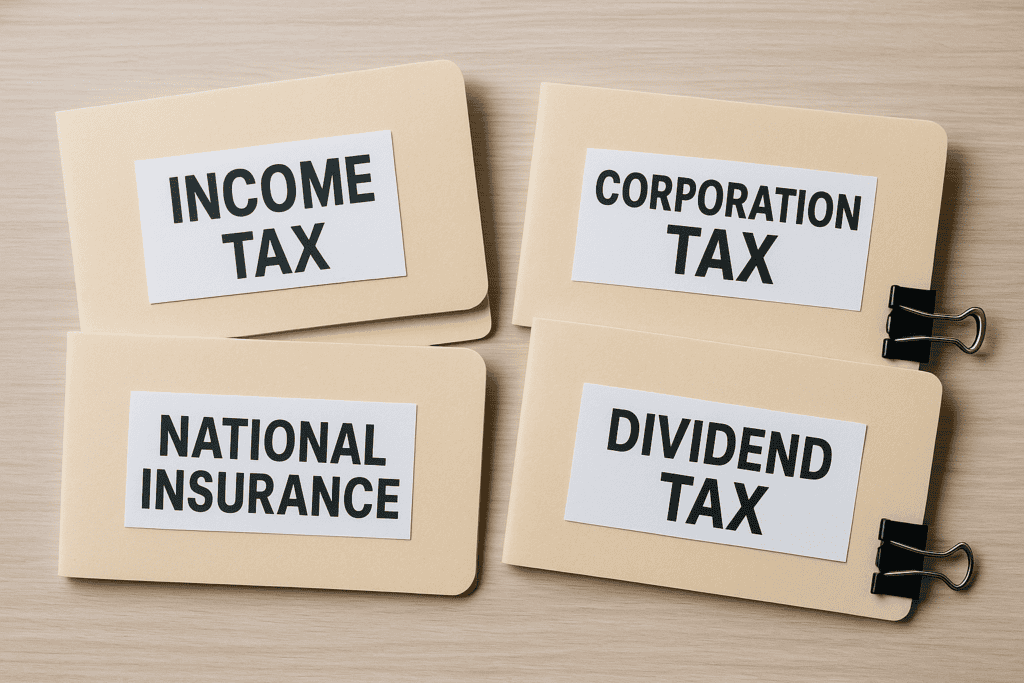
Tax differences: Income Tax and National Insurance vs Corporation Tax and dividend tax
A sole trader pays tax on business profits through Income Tax and National Insurance (NI). A limited company pays Corporation Tax on company profits, while the owner typically pays personal tax on money taken out as salary and dividends. The two routes can produce different tax bills at the same profit level, because they apply different rates, thresholds, and reporting rules.
| Area | Sole trader | Limited company |
|---|---|---|
| Taxed amount | All taxable profit is treated as personal income. | Company profit taxed first; owner taxed on salary/dividends taken. |
| Main tax rates (2025/26) | Income Tax: 20% basic, 40% higher, 45% additional (England, Wales, NI). | Corporation Tax: 19% small profits rate up to £50,000; 25% main rate from £250,000 (marginal relief in between). |
| National Insurance | Class 4 NI: 6% on profits £12,570–£50,270; 2% above (2025/26). | NI depends on salary; dividends do not attract NI. |
| Dividend tax (2025/26) | Not applicable. | Dividend allowance £500; rates: 8.75% (basic), 33.75% (higher), 39.35% (additional). |
In practice, sole traders often face a straightforward calculation: profit less allowable expenses, then Income Tax and Class 4 NI. For example, a £60,000 profit in 2025/26 pushes part of income above the £50,270 higher-rate threshold, and Class 4 NI applies at 6% up to £50,270 and 2% above that level.
Limited companies can separate profit from personal drawings. A director-shareholder might take a smaller salary and extract the rest as dividends, which avoids NI on dividends but introduces dividend tax and company-level Corporation Tax. This structure can improve tax efficiency for some profit levels, but it increases compliance: company accounts, a Corporation Tax return, and payroll if a salary is paid.
Check current thresholds and rates on Income Tax rates, National Insurance rates, Corporation Tax rates, and dividend tax before deciding.
Liability and risk: personal exposure, business debts, and professional indemnity considerations
A single claim or unpaid invoice can put personal assets at risk. Under UK sole trading, business debts attach to the individual, so a £25,000 supplier dispute or a £10,000 tax arrears demand can become personal liability. A limited company usually limits exposure to the company’s assets because the company is a separate legal person, although directors can still face personal liability for guarantees, wrongful trading, or unpaid taxes in specific circumstances.
The practical solution is to match structure and insurance to the risk profile. Start by listing your largest contract value, typical credit terms, and any regulated advice or design work that could trigger a negligence claim. Next, confirm whether clients require Professional Indemnity Insurance (PII); many agencies and consultants see minimum limits of £1 million to £2 million in contracts.
Implement by reviewing terms, removing personal guarantees where possible, and pricing insurance into fees. This reduces the chance that a business dispute affects your home, savings, or personal credit. For guidance on legal responsibilities and company separation, review GOV.UK and Companies House.
Administration and compliance: self assessment vs Companies House filings and payroll duties
In 2023/24, HM Revenue & Customs recorded 4.4 million Self Assessment taxpayers with self-employment income, showing how common the sole trader route remains (HMRC). As a sole trader, you report profits once a year through Self Assessment, with the filing deadline on 31 January after the tax year ends. A limited company must file annual accounts and a confirmation statement with Companies House, and submit a Company Tax Return to HMRC within 12 months of the accounting period end. If you pay yourself or staff through PAYE, you also run payroll and report in real time under RTI.
Costs and cash flow: set-up fees, accountancy costs, and allowable expenses
Priya starts a Bristol-based web design studio and invoices £3,000 a month. She trades as a sole trader for speed, then considers incorporating after a client asks for monthly management accounts and a dedicated business bank account. The decision becomes a cash-flow question: what does each structure cost to run, and when do those costs arrive?
As a sole trader, Priya can begin trading with no incorporation fee, then budget for bookkeeping software and an annual Self Assessment submission. Many sole traders pay an accountant for year-end accounts and a tax return, often costing £300–£1,000+ depending on complexity and VAT registration. Cash flow can feel simpler because profits move into personal funds, but the owner must ring-fence money for Income Tax and National Insurance due by 31 January and 31 July.
A limited company adds fixed compliance costs. Companies House charges £50 to incorporate online (as of February 2026) via GOV.UK, and most directors pay more for accountancy support because statutory accounts and Corporation Tax returns require tighter formatting. Annual accountancy fees often sit around £800–£2,500+ for small service companies, especially once payroll and dividends enter the picture.
Both structures can claim allowable expenses, but the company route can make separation clearer. Priya can pay for software subscriptions, professional insurance, and a proportion of home-working costs, while keeping spending inside the company bank account to protect cash-flow discipline.
Credibility and growth: winning contracts, hiring staff, and raising finance
Sole traders often win work on personal reputation, while limited companies can signal permanence and governance. Many public-sector and larger private buyers ask for a registered company number and published accounts via Companies House, which can favour incorporation for tendering.
A sole trader hires staff directly and carries employer obligations personally; a limited company hires through the company, which can simplify scaling teams and issuing share options. For finance, lenders may still request personal guarantees, yet limited companies can access equity investment by issuing shares, while sole traders cannot. In 2024, UK private equity and venture capital investment totalled £9.0 billion (British Private Equity & Venture Capital Association, BVCA).
Decision framework: scenarios where sole trader fits best vs when incorporation makes sense
Choosing the wrong structure can create a measurable cost: a £25,000 supplier dispute can attach to personal assets as a sole trader, while incorporation can add £34 to register and recurring accountancy fees. The decision becomes clearer when you match your risk, client demands, and profit profile to the structure.
Use sole trading when you need speed, low overheads, and you can tolerate personal exposure. This route suits testing a service for 3–6 months, working with individuals or small firms, and keeping administration to one annual return through HMRC Self Assessment.
Incorporate when contracts require a company number, when you plan to hire, or when you want clearer separation between business and personal finances. Implementation is practical: register with Companies House, open a business bank account, set up payroll if you take a salary, and track dividends properly.
Results usually show up as reduced personal risk, improved tender eligibility, and more predictable governance as revenue moves beyond £50,000–£100,000 a year.
Frequently Asked Questions
What are the legal and tax differences between operating as a sole trader and forming a limited company in the UK?
As a sole trader, you and the business are the same legal entity, so you hold personal liability for debts. A limited company is a separate legal person, usually limiting liability to share capital. Sole traders pay Income Tax and Class 2/4 National Insurance via Self Assessment; companies pay Corporation Tax, with directors taxed on salary and dividends.
How do National Insurance contributions differ for sole traders compared with directors of limited companies?
Sole traders pay National Insurance through Self Assessment: Class 2 (a flat weekly amount when profits exceed the threshold) and Class 4 (a percentage of taxable profits). Directors of limited companies pay Class 1 National Insurance on salary via PAYE, while dividends do not attract National Insurance. Employer Class 1 may also apply.
At what profit level does a limited company typically become more tax-efficient than sole trader status?
For many UK businesses, a limited company often becomes more tax-efficient once annual profits reach roughly £30,000–£50,000, assuming some profit can be taken as dividends. The crossover depends on the director’s other income, salary level, and dividend allowance. Professional advice usually pays off once profits exceed £40,000.
How does personal liability for debts and legal claims differ between a sole trader and a limited company?
A sole trader holds unlimited personal liability, so business debts and legal claims can be enforced against personal assets such as savings or a home. A limited company is a separate legal entity, so liability usually stays with the company and is limited to company assets or unpaid share capital. Directors can still face personal liability for fraud, wrongful trading, or personal guarantees.
What reporting, accounting, and Companies House filing obligations apply to a UK limited company compared with a sole trader?
A UK limited company must file annual accounts and a confirmation statement with Companies House, submit a Company Tax Return (CT600) to HMRC, and run payroll if paying directors or staff. Directors must keep statutory registers and maintain accurate records for at least 6 years. A sole trader reports via Self Assessment and keeps records for 5 years after 31 January.
How do lenders and clients assess credibility and risk differently for sole traders versus limited companies?
Lenders often view limited companies as lower risk because Companies House filings and separate accounts provide verifiable financial history. Sole traders rely on personal credit scores, SA302s and tax year overviews, and 2–3 years of accounts. Clients may prefer limited companies for perceived stability, formal contracts, and professional indemnity cover, while sole traders build trust through references and a clear track record.