Food safety professionals protect consumers and support business continuity by preventing contamination and managing risk. The role demands more than technical knowledge; it requires practical skills that translate standards into daily control. This guide outlines five core capabilities that employers value across manufacturing, catering, and retail. Each skill includes clear, realistic ways to build competence through training, workplace practice, and structured feedback, so performance improves and compliance becomes consistent.
Key takeaways
- Master hazard analysis and risk assessment to prevent contamination across the supply chain.
- Build strong HACCP skills by practising plan design, validation, and routine verification.
- Strengthen audit competence through structured checklists, evidence gathering, and corrective actions.
- Improve regulatory knowledge by tracking updates and applying requirements to site procedures.
- Develop clear communication to train teams, influence behaviour, and report non-conformities.
- Use data skills to trend results, spot issues early, and target improvements.
Role and responsibilities of a modern food safety professional
A modern food safety professional protects consumers and supports business continuity by preventing foodborne illness and managing risk across the supply chain. The role blends science, regulation and practical operations. Daily work often starts with verifying that hazard controls function as designed. That includes checking critical limits, reviewing monitoring records and confirming corrective actions when a process drifts out of control.
Risk assessment sits at the centre of the job. Many teams use Hazard Analysis and Critical Control Points (HACCP), a structured method for identifying hazards and setting controls. Guidance from the Food Standards Agency helps professionals interpret expectations for UK food businesses. A competent practitioner also aligns site programmes with recognised standards where relevant, such as BRCGS, and prepares evidence for external audits.
Responsibilities extend beyond paperwork. A food safety professional trains colleagues, coaches supervisors and builds a culture where staff report issues early. Clear communication matters when explaining allergen controls, cleaning validation, or why a temperature check must happen at a set time. Incident management also forms a key duty. When a complaint, test result or supplier alert signals a potential hazard, the professional leads the investigation, assesses consumer risk, and coordinates actions such as product hold, traceability checks and recall readiness.
Modern practice relies on data. Professionals trend microbiology results, environmental monitoring and non-conformance reports to spot patterns before they become failures. Supplier assurance also demands attention, since ingredients and packaging can introduce hazards. Regular review of specifications, certificates and performance data helps maintain control across sites and borders.
Regulatory compliance remains constant. A food safety professional keeps procedures current with legal requirements, supports inspections, and documents decisions in a way that stands up to scrutiny. The role demands calm judgement, strong ethics and consistent follow-through.
Skill 1: Hazard analysis and risk assessment (HACCP)
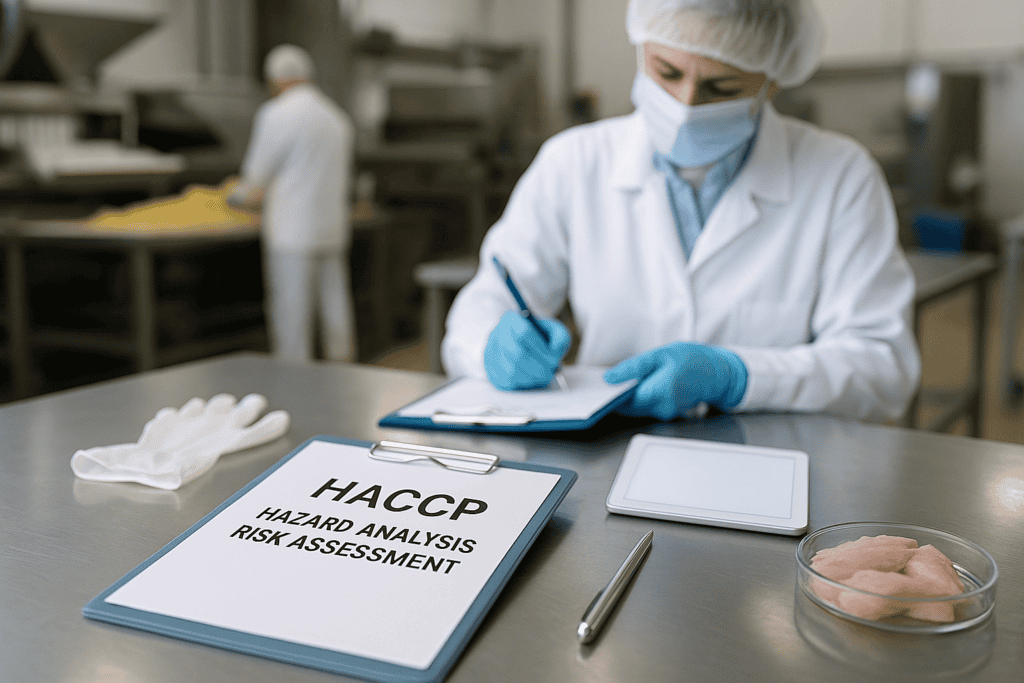
Hazard analysis and risk assessment sit at the centre of effective food safety management. HACCP, which stands for Hazard Analysis and Critical Control Points, provides a structured method to identify hazards that could make food unsafe, assess the risk posed by each hazard, and set controls that prevent, remove, or reduce the hazard to an acceptable level. A competent practitioner can distinguish between biological, chemical, and physical hazards, then evaluate severity and likelihood using evidence from the process, ingredients, equipment, and intended consumers.
Strong HACCP skill also means translating analysis into practical control points, clear critical limits, and workable monitoring. That work must align with recognised standards and customer requirements, while remaining realistic for production teams. When changes occur, such as a new supplier, recipe, or line speed, the analysis must be reviewed promptly so controls remain valid.
To build this skill, combine formal training with supervised application on real processes. A course such as BRCGS Hazard Analysis and Critical Control Points (HACCP) can strengthen method, terminology, and documentation. Practical competence grows fastest when training links to site walk-throughs, data review, and challenge from experienced colleagues.
Skill 2: Food safety legislation, standards, and audit readiness
Food safety professionals must translate legal duties and voluntary standards into daily controls that auditors can verify. In the United Kingdom, core requirements sit within the Food Hygiene (England) Regulations 2006 and retained EU law such as Regulation (EC) No 852/2004 on the hygiene of foodstuffs. Competence means knowing what each rule expects, where it applies, and how to evidence compliance through records, training, and verification.
Standards add structure and common language across sites and suppliers. Many businesses align with schemes recognised by the Global Food Safety Initiative (GFSI), such as BRCGS or SQF. Audit readiness requires more than tidy paperwork. A capable practitioner maps clauses to procedures, checks that staff follow those procedures, and tests traceability and recall processes under time pressure.
To build this skill, read the primary legislation, then compare it with your site’s food safety management system. Shadow internal audits, practise writing clear non-conformance statements, and learn to present objective evidence. Regular dialogue with enforcement guidance from the Food Standards Agency also helps you keep pace with change.
Skill 3: Microbiology and contamination control in food operations
Microbiology knowledge helps food safety professionals prevent foodborne illness by controlling pathogens, spoilage organisms, and allergens. Strong competence starts with understanding how bacteria, viruses, yeasts, and moulds behave in real operations. Growth depends on time, temperature, moisture, acidity, oxygen, and nutrients. That knowledge turns into practical decisions on chilling, cooking, hot holding, cooling, and storage life, while also supporting safe thawing and portioning practices.
Contamination control also requires clear thinking about routes of transfer. Raw-to-ready-to-eat cross-contamination often occurs through hands, utensils, slicers, cloths, and poorly planned workflows. Effective professionals map product and people movement, then set controls such as segregation, validated cleaning and disinfection, and hygienic zoning. Environmental monitoring can verify that controls work, especially in high-risk areas where Listeria monocytogenes can persist, including drains, floors, and hard-to-clean equipment joints.
To build this skill, use structured training and apply it on the floor. The Food Standards Agency provides practical guidance on food hygiene and microbiological risks. Laboratory reports also offer learning value when teams review trends, investigate root causes, and confirm corrective actions through follow-up sampling, then share findings with supervisors to strengthen day-to-day controls.
Skill 4: Root cause analysis and corrective action management
Root cause analysis turns a recurring issue into a controlled risk. Instead of treating symptoms, a competent professional identifies why a failure happened and removes the conditions that allowed it. That approach reduces repeat non-conformances, protects consumers, and saves time during audits.
Effective practice starts with a clear problem statement and good evidence. A strong investigator gathers facts from records, observations, and interviews, then tests each assumption against what actually occurred. Tools such as the “5 Whys” and fishbone (Ishikawa) diagrams help structure thinking, yet evidence must drive conclusions. Training in Root cause analysis builds the discipline to separate contributing factors from the true cause.
Corrective action management then converts findings into lasting control. A corrective action fixes the immediate problem, while a preventive action stops recurrence by strengthening the system. Clear ownership, realistic deadlines, and measurable outcomes keep actions effective. Verification matters as much as implementation; a professional checks that changes work in practice, not only on paper.
- Containment: protect product and consumers straight away (for example, hold affected stock and assess safety).
- Correction: restore control at the point of failure (such as recalibrating a probe or re-training an operator).
- Corrective action: remove the cause (for example, redesign a check, update maintenance, or change a supplier control).
- Effectiveness review: confirm sustained improvement using trend data, internal audits, and repeat checks.
To build this skill quickly, practise on real, low-risk incidents such as minor label errors or temperature record gaps. Keep investigations time-bound, document evidence clearly, and track actions to closure. Strong habits here improve audit outcomes and strengthen the food safety culture across the site.

Skill 5: Clear communication, training, and safety culture leadership
Clear communication turns technical controls into consistent daily practice. Food safety professionals must explain risk in plain language, tailor messages to different roles, and confirm understanding on the shop floor. Strong communicators also write usable procedures, record findings without ambiguity, and present audit outcomes in a way that prompts action rather than defensiveness.
Training skill matters because competence depends on behaviour, not documents. Effective trainers set clear learning outcomes, use short demonstrations, and check performance in real tasks, such as allergen changeovers or probe calibration. Refresher training should follow trend data, near misses, and non-conformances, so the programme targets real gaps rather than repeating generic content.
Safety culture leadership links standards to accountability. A credible leader listens, removes barriers, and reinforces expectations through routine coaching and visible follow-up. That approach supports reporting, reduces concealment, and helps teams treat food safety as a shared responsibility.
To build this skill, seek structured learning in communication and training methods, then practise through toolbox talks, audit close-out meetings, and cross-functional projects. Use recognised guidance on food safety culture, such as resources from the BRCGS, and align internal messaging with the Food Standards Agency expectations for safe, honest food.
How to build and prove these skills through qualifications and CPD
Build competence by combining recognised qualifications with planned continuing professional development (CPD). Choose training that maps to your role and your site risks, then set clear outcomes such as “verify CCP monitoring”, “lead an internal audit”, or “write a corrective action plan that closes on time”. A structured route also helps you avoid gaps between technical knowledge and day-to-day application.
Use accredited or widely recognised courses to evidence capability. For example, HACCP qualifications support hazard-based thinking, while auditing and food hygiene management courses strengthen compliance and verification skills. Where you need flexible options, Sirius Training and Certification Services provides training and certification routes that can align with operational responsibilities and audit expectations.
Prove skills through workplace evidence, not attendance alone. Maintain a CPD log that records what you learned, how you applied it, and what changed as a result. Pair that record with objective outputs such as updated risk assessments, improved trend reports, validated cleaning checks, or training materials that reduce repeat errors. Regular manager sign-off and periodic self-assessment against your job description will keep development focused and credible.
Measuring competence: practical assessments, evidence, and career progression
Competence becomes credible when assessment reflects real work, not attendance. Practical assessments should test observation, judgement, and follow-through. For example, a manager can ask for a short site walk to identify priority risks, then require a written action plan with owners, deadlines, and verification steps. Evidence should show both performance and consistency, so keep dated records such as internal audit reports, corrective action logs, training evaluations, and trend reviews of complaints or test results.
Use a simple evidence matrix that maps each key skill to proof. That approach helps during appraisals and external audits, and it also highlights gaps for targeted CPD. Where formal recognition adds value, align evidence to professional standards and maintain a CPD log that states the activity, learning outcome, and how the site applied the learning. The Institute of Food Science & Technology (IFST) and the Institution of Occupational Safety and Health (IOSH) provide useful frameworks for structured development.
Career progression usually follows scope and influence. Move from task delivery to leading systems, then to shaping culture and strategy. Seek opportunities to lead an internal audit programme, mentor supervisors, or present risk updates to senior leaders, and capture outcomes as measurable improvements.
Frequently Asked Questions
What are the five core skills every food safety professional needs to succeed?
Food safety professionals need five core skills: hazard analysis and risk assessment; knowledge of food safety law and standards; audit and inspection competence; clear communication and training delivery; and incident management, including root cause analysis and corrective actions. These skills support prevention, compliance, and rapid response across the food supply chain.
How can a food safety professional build stronger hazard analysis and risk assessment skills?
Build hazard analysis and risk assessment skills by practising structured hazard identification across each process step, then rating likelihood and severity with a clear risk matrix. Validate assumptions using incident data, audits, and scientific guidance. Join cross-functional reviews, run mock recalls, and document decisions. Seek mentoring and formal training in HACCP and root cause analysis.
Which training routes help improve audit and inspection competence in food safety roles?
Improve audit and inspection competence through accredited internal auditor training (HACCP and food safety management systems), lead auditor courses aligned to ISO 22000 or FSSC 22000, and regulator-style inspection training. Strengthen skills with supervised on-site audits, mentored shadowing, and calibrated assessment using real non-conformance reports and corrective action reviews.
How can food safety professionals strengthen root cause analysis and corrective action planning?
Strengthen root cause analysis by using structured methods such as the 5 Whys and fishbone diagrams, supported by accurate data and clear problem statements. Confirm causes with evidence, not assumptions. Build corrective action plans with defined owners, deadlines, verification steps, and success measures. Review effectiveness after implementation and update procedures, training, and controls to prevent recurrence.
What practical steps help develop clear communication and training skills for food safety compliance?
Use plain language and define key terms. Tailor messages to each role and translate requirements into simple actions. Create short, visual training materials and standard scripts for critical tasks. Practise briefings and coaching during routine checks, then invite questions. Confirm understanding with demonstrations and quick quizzes. Record feedback and update training after incidents, audits, or process changes.