David Nyström
New Member
Hi, I'm an expert on net-zero and renewable energies from Finland. Finland is worlds leading country in the transition to renewable energies and achieving net-zero emission and I would like to offer my expertise in this field as we are entering a new economic boom.
Current world political circumstances have a bit unexpectedly pushed us into a new economic boom, which is an energy self-reliance boom. It's not only about collective national self-reliance where councils are expected to arrange heat and power locally, but also about individual self-reliance. We have collectively agreed to transition away from the dependency of fossil fuels by 2050 which as we all know is de facto monopolized to a handful of very large companies and the state. So in order to achieve this, the means to produce energy with renewables are granted to each and every one of us. That's the boom. They are slowly de-monopolizing the grid and out phasing nuclear power and large scale dispatchable power generation. Many people are panicking that it's some kind of madness that de-industrializing the country, but it's actually about transitioning into a new economic structure.
The first opportunity to sell surplus electricity to the main grid in the UK was introduced with the Feed-in Tariff scheme in 2010, which has since been replaced by the Smart Export Guarantee (SEG) in 2020. This was the first step towards this new economic model where anyone can produce electricity to the grid. It hasn't been very attractive so far because it hasn't been profitable, because the electricity price has been low and for example solar panels have been expensive and inefficient. So it has quite slowly become actually feasible and these energy crisis are now causing that rapidly.
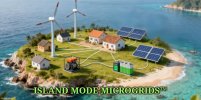
For this purpose I'm introducing a bundled final product that's called a microgrid. It's not my innovation. It's an actual thing. You can look it up. It's a micro scale stand alone hybrid grid that utilizes few different, typically three or four renewable sources to achieve a stable and reliable energy output. This allows the property to become energy self-reliant. That means no electricity bills, no VAT on electricity, no transmission fees and you are able to produce the fuel for your vehicle, if it's an EV. It also offers an energy arbitrage opportunity where you can sell the surplus electricity to the main grid when the demand and price is high.
This final product is a quite sophisticated system so it requires professional planning, where we have to assess the location for what is feasible. How sunny? How windy? Is there a moving body of water nearby? Is there organic waste? etc. Then how the different energy sources work together and how to take best advantage of the energy arbitrage opportunity. Each location needs to be assessed individually for an efficient and optimal solution. So I am at your service and happy to discuss renewables and to answer any of your questions regarding it. I'm looking for business partners in the UK and look forward to meeting people who are as passionate as I am about clean energy self-reliance technologies.
Current world political circumstances have a bit unexpectedly pushed us into a new economic boom, which is an energy self-reliance boom. It's not only about collective national self-reliance where councils are expected to arrange heat and power locally, but also about individual self-reliance. We have collectively agreed to transition away from the dependency of fossil fuels by 2050 which as we all know is de facto monopolized to a handful of very large companies and the state. So in order to achieve this, the means to produce energy with renewables are granted to each and every one of us. That's the boom. They are slowly de-monopolizing the grid and out phasing nuclear power and large scale dispatchable power generation. Many people are panicking that it's some kind of madness that de-industrializing the country, but it's actually about transitioning into a new economic structure.
The first opportunity to sell surplus electricity to the main grid in the UK was introduced with the Feed-in Tariff scheme in 2010, which has since been replaced by the Smart Export Guarantee (SEG) in 2020. This was the first step towards this new economic model where anyone can produce electricity to the grid. It hasn't been very attractive so far because it hasn't been profitable, because the electricity price has been low and for example solar panels have been expensive and inefficient. So it has quite slowly become actually feasible and these energy crisis are now causing that rapidly.
For this purpose I'm introducing a bundled final product that's called a microgrid. It's not my innovation. It's an actual thing. You can look it up. It's a micro scale stand alone hybrid grid that utilizes few different, typically three or four renewable sources to achieve a stable and reliable energy output. This allows the property to become energy self-reliant. That means no electricity bills, no VAT on electricity, no transmission fees and you are able to produce the fuel for your vehicle, if it's an EV. It also offers an energy arbitrage opportunity where you can sell the surplus electricity to the main grid when the demand and price is high.
This final product is a quite sophisticated system so it requires professional planning, where we have to assess the location for what is feasible. How sunny? How windy? Is there a moving body of water nearby? Is there organic waste? etc. Then how the different energy sources work together and how to take best advantage of the energy arbitrage opportunity. Each location needs to be assessed individually for an efficient and optimal solution. So I am at your service and happy to discuss renewables and to answer any of your questions regarding it. I'm looking for business partners in the UK and look forward to meeting people who are as passionate as I am about clean energy self-reliance technologies.